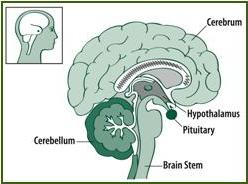
What is the Pituitary Gland?
The pituitary gland is a small gland, located below the brain and connected to the hypothalamus. The pituitary gland regulates the secretions of hormones in the body, and hormones impact metabolism, growth and development, reproduction and urine production. It is important to note that the hypothalamus and pituitary gland are connected by blood vessels and nerves.
When the body experiences changes, perhaps in temperature, the hypothalamus responds to restore our body’s balance (homeostasis). The hypothalamus stimulates the pituitary gland to release hormones that in term stimulate various organs in the body to respond. The pituitary gland has cells that respond independently to the stimulus. Some cells make one type of hormone, other cells produce other hormones. The pituitary gland is often referred to as the master gland.
The hormones produced and the body’s response follows:
Pituitary Hormones
Growth Hormone (GH)
signals certain liver cells to produce somatomedin-C, which is needed for growth in childhood
Prolactin
stimulates breast milk production and controls menstrual periods.
Adrenocorticotropic hormone (ACTH)
stimulates the adrenal glands to release cortisol and aldosterone that helps the body to regulate stress.
Thyroid-stimulating hormone (TSH)
stimulates the release of thyroid hormones, which play a major role in basal metabolic rate, the way the body’s cells convert food into energy.
Follicle Stimulating Hormone (FSH)
stimulates the production of testosterone and estrogen and progesterone.
Luteinizing Hormone (LH)
also stimulates the hormones that regulate reproduction.
Melanocyte
stimulating hormone controls skin pigmentation.
Antidiuretic hormone (ADH)
also referred to as vasopressin, increases the absorption of water by the kidneys into the blood.
Oxytocin
is produced by the hypothalamus and stored in the pituitary gland until released. Ocytocin causes the uterus to contract during childbirth and stimulates milk production.
Where is the Pituitary Gland Located
The location of the pituitary gland should be noted as well. The pituitary gland sits below the crossing fibers of the optic nerves. On either side of the pituitary gland are the carotid arteries and nerves that control eye movements.
More about the Pituitary
The pituitary gland is called the “Master Gland” of the endocrine system because it controls the functions of all the other endocrine glands. From its lofty position above the rest of the body, it sends signals to the thyroid gland, adrenal glands, ovaries and testes, directing them to produce thyroid hormone, cortisol, estrogen, testosterone, and many more. These hormones have dramatic effects on metabolism, blood pressure, sexuality, reproduction, and other vital body functions. This “Master Gland” role makes the pituitary gland quite important, despite its small size.
Diseases and symptoms involving the pituitary gland are varied. Some diseases are related to an overproduction of a specific hormone, or too little to no production. A growth in the pituitary gland could put pressure on the optic nerve or the carotid artery. Surgery involving the pituitary gland is done using minimally invasive, microscopic surgery. The surgeon can go through the sphenoid sinus and there are no visible scars.
Discover more from Cushing's Help
Subscribe to get the latest posts sent to your email.